Psychology has a remarkably efficient way of making an unanswered question look answered: give the phenomenon a name, then use the name to explain the phenomenon.
Patricia Churchland illustrated a related mistake with an unlikely source: a Betty Crocker microwave cookbook. Its explanation began reasonably enough. Microwaves excite the molecules in food. The molecules move more vigorously. Then came the extra step: the molecules collide, create friction, and thereby produce heat.
For Churchland, the conceptual error was treating the food’s thermal condition as an additional thing manufactured by the molecular activity, rather than recognising that we were describing the same physical system at different levels. In modern thermodynamic terminology, heat is energy transferred because of a temperature difference; temperature and internal energy describe aspects of the system’s thermal state. The philosophical point survives that clarification: an explanation goes wrong when it inserts a separate entity where an account of the underlying organisation would do.
Churchland applied the argument to consciousness. Perhaps conscious states would ultimately be identified with particular forms of neural activity, rather than remaining separate things those activities somehow produced. She presented this as a scientific prospect, open to revision by evidence. The cookbook did not settle the philosophy of mind.
When the description becomes the cause
The analogous temptation in psychology is reification: turning an abstraction into an independently established thing.
Someone avoids social situations, anticipates humiliation and experiences intense bodily arousal. We summarise that pattern as social anxiety. Asked why they avoid social situations, we answer: because they have social anxiety.
That may be useful shorthand between clinicians. As a causal explanation, it has barely moved us forward.
The same problem arises with obsessionality. We observe checking, reassurance seeking, rumination and difficulty tolerating uncertainty. We name the pattern, then invoke the name to account for the very observations from which it was inferred. The vocabulary becomes more sophisticated; the explanation remains circular.
A diagnosis can organise information, aid communication and guide assessment. Those are substantial achievements. A diagnostic label alone does not tell us which processes generated or maintain a particular person’s difficulties.
Identity deserves the same scrutiny
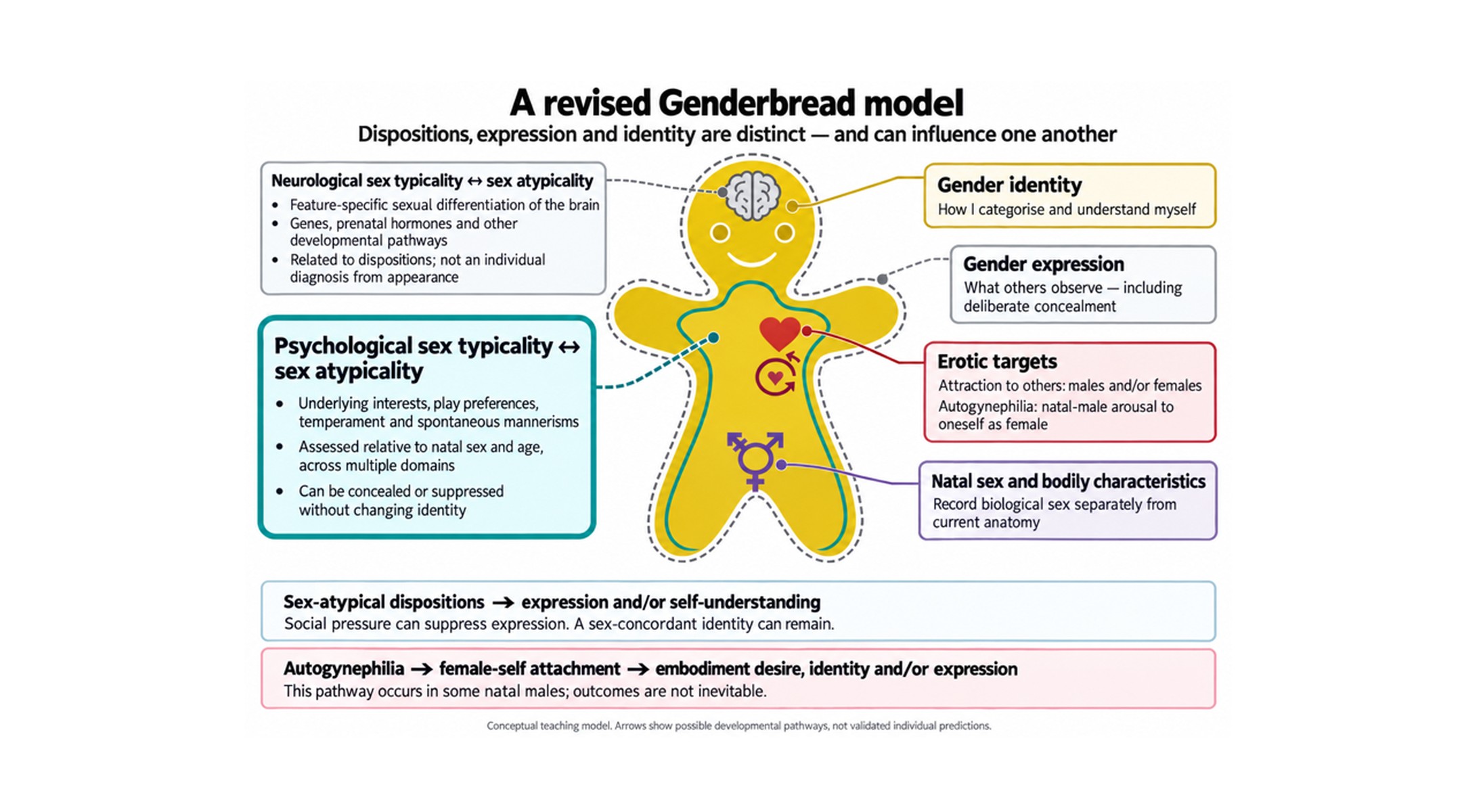
Identity language can undergo the same promotion. We observe a pattern of self-concept, emotion, preferences and behaviour, describe it as an identity, and then explain the pattern by invoking that identity.
This is especially tempting when an identity carries personal significance or moral weight. Questioning its explanatory status can then be mistaken for questioning the person’s experience. But the experience and the explanation are different claims. Taking someone seriously includes trying to understand how their experience works.
An established self-concept may organise attention, interpretation, memory and action. A person who expects rejection, for example, may notice ambiguous social cues selectively, interpret them as rejection, withdraw, and lose opportunities to revise the expectation. There is a proposed process here that can be examined. Simply saying “because of their identity” leaves that work undone.
The same standard should apply to a preferred psychological theory, a diagnostic category or an identity narrative. Personal conviction and professional familiarity cannot establish a mechanism.
A useful test for our explanations
Remove the label. What remains?
Can we describe the relevant learning history, reinforcement, appraisal, motivation, attentional bias, temperament, neurobiology or social contingency? Can we say what evidence would distinguish that account from a plausible alternative? Can we identify an observation that would count against it?
If we can, the construct may be doing useful scientific work. If the explanation collapses as soon as the label is removed, we should be curious about what the label was concealing.
Clinical language should compress complexity. It should not substitute for explaining it.
Adapted and expanded from my original LinkedIn post. Read Patricia Smith Churchland’s “Can Neurobiology Teach us Anything about Consciousness?”