If you have sat through a gender-diversity training session, worked in a school, or brought a gender-questioning child to a clinician in the past decade, you have probably met the Genderbread Person. It is a friendly gingerbread figure: gender identity in the head, attraction in the heart, sex in the pelvis, and gender expression traced around the outside. Its cousin, the Gender Unicorn, does the same job with a rainbow.
I used to show it too. I no longer do, and I now suggest colleagues retire it. Not because it separates things that belong together—distinguishing sex, gender identity and sexual orientation is genuinely useful—but because it leaves out the ingredient that, for many of the people it is handed to, does most of the explanatory work.

A cartoon that became a curriculum
The Genderbread Person was popularised by educator Sam Killermann, who published his first version in 2011, placed his work in the public domain in 2013 and released a fourth version in 2018 (Killermann). Similar “genderbread” activities circulated earlier, including in a 2007 Routledge social-justice teaching text. Killermann’s figure anchors the Safe Zone Project curriculum, which reports use by tens of thousands of educators in at least 100 countries. The Gender Unicorn, created by Trans Student Educational Resources in 2014–15 and free to reuse, has the same architecture: gender identity, gender expression, sex assigned at birth, and physical and emotional attraction.
Both have travelled well beyond activist workshops:
- Australian schools. A South Australian public-school Year 7 health unit tells teachers to “refer to the Gender Unicorn,” as quoted in state parliament in 2023. ReachOut’s Years 7–8 schools lesson is built around the Gender Unicorn and mapped to the Australian Curriculum and the NSW and Victorian syllabuses. The Genderbread Person has turned up in Queensland and NSW high-school classes; one NSW school withdrew it in 2020, the Department noting it had not developed the resource.
- Government and public agencies. Canada’s Library of Parliament reproduced the Genderbread Person in a 2018 terminology explainer. In the United States, the Gender Unicorn appears in a District of Columbia education department training deck, a Massachusetts Department of Public Health guide for caregivers and educators, and conference materials on LGBTQ youth in California’s juvenile courts.
- Curricula elsewhere. Ontario’s health and physical education body Ophea offers a Gender Unicorn activity for Grades 1–12. In the UK, Policy Exchange’s 2023 review of relationships and sex education found the Genderbread Person in several curriculum resources. In Belgium, a Dutch-language “Genderkoek” used in Flemish school workshops prompted a 2021 parliamentary question.
- Clinical and academic training. The Genderbread Person appears as a figure in a Cambridge University Press clinical text on women’s health care, in books for adolescents from the American Psychological Association’s children’s imprint, and in peer-reviewed medical-school curricula; in one, every learner was given a laminated Genderbread card (Gavzy et al., 2019). An Australian team has adapted the Gender Unicorn into a psychometric gender identity scale (Ho & Mussap, 2019).
A teaching heuristic does not need to be complete to be useful. But when a cartoon becomes the default conceptual framework offered to parents, children, teachers and therapists, its omissions become everyone’s omissions. What is not on the chart tends not to be considered.
The missing ingredient: sex-typed dispositions
What the Genderbread leaves out is what researchers variously call childhood gender nonconformity, sex-typed behaviour or psychological sex typicality: the cluster of interests, play and peer preferences, temperament, cognitive style and spontaneous mannerisms on which males and females differ on average, and on which some individuals sit far from the average for their sex. In natal males, a hypomasculinised version of this profile is common among androphilic (same-sex attracted) men; in natal females, the mirror image—a hypermasculinised profile—is common among gynephilic women.
These dispositions are not identities. A feminine boy does not need to think of himself as anything in particular to prefer dress-ups, dolls and the company of girls. Nor are they expression, in the sense the Genderbread uses the word. Expression is enaction: what we present to others. Dispositions are what we gravitate towards when no one is directing us, and they often appear before a child has any settled concept of gender categories at all.
Nor are they a stereotype that exists only in the eye of the beholder. Sex-atypical traits in gay men and lesbian women are among the largest and most replicated effects in individual-differences psychology.
- A meta-analysis of retrospective studies found large differences in recalled childhood sex-typed behaviour between homosexual and heterosexual adults—roughly d = 1.3 for men and 1.0 for women—while prospective studies showed that marked childhood femininity strongly predicts later homosexuality in boys (Bailey & Zucker, 1995).
- Because recall can be biased, Rieger and colleagues (2008) had raters judge childhood home videos. Children who grew up to be gay or lesbian were rated more gender nonconforming than those who grew up heterosexual, in both sexes, and the difference persisted into adulthood.
- In a British birth cohort of more than 4,500 children, sex-typed behaviour measured at ages 3.5 and 4.75 predicted sexual orientation at 15 (Li, Kung & Hines, 2017). In a Dutch general-population sample, childhood gender variance was associated with an 8- to 15-fold higher rate of adult homosexuality, but not with adult gender discomfort (Steensma et al., 2013).
- In adults, gay men and lesbian women differ most from heterosexual peers not on self-rated “instrumentality” or “expressiveness,” but on gender-typed occupational preferences (Lippa, 2002). The pattern held across five Western nations and regions in a very large BBC internet survey (Lippa, 2008).
- It is cross-cultural. In Samoa, the occupational preferences of fa’afafine—feminine, androphilic males recognised as a third gender—were indistinguishable from women’s (Semenyna & Vasey, 2016). Similar shifts appear among the muxes of Oaxaca and in Thailand, where one recent study found an effect size of about 1.6 for gay men’s recalled female-typical childhood behaviour (Gómez Jiménez et al., 2021, 2025).
- It is partly heritable. In an Australian twin study, of the traits measured—including sexual orientation itself—only childhood gender nonconformity was significantly heritable in both sexes (Bailey, Dunne & Martin, 2000).
These are average differences with wide overlap, not a template for any individual. Many gay men were conventionally masculine boys, and not every trait shifts: on interest in uncommitted sex and in visual sexual stimuli, gay men look much like heterosexual men. But on childhood play, interests and occupational preferences, the shift is large by any standard in psychology.
Expression is not disposition
The version reproduced above defines expression as what a person externalises based on their gender identity. Killermann’s own versions are more careful, presenting expression as a separate continuum from identity rather than its outward face. But in every version, expression is presentation, and treating presentation as the visible form of gendered difference collapses two things that come apart constantly in real life.
First, expression can run ahead of disposition. Clothing, hair, make-up and styles of self-presentation can be fashion, subculture, art, flirtation or political protest. A heterosexual musician in eyeliner and nail polish is expressing something, but it may tell you little about his temperament or interests.
Second, and clinically more important, disposition can be hidden by expression. Many feminine boys learn early that their mannerisms attract teasing and rejection, including from parents and peers (Landolt et al., 2004), and many “defeminise” across adolescence (Taywaditep, 2002). Among 751 American gay men, most rated masculinity as important, and on average they wished their behaviour were more masculine and less feminine than they perceived it to be (Sánchez & Vilain, 2012). Many masculine girls learn to soften what they can, in the same way.
Yet the underlying disposition often remains visible. Observers can judge sexual orientation at better-than-chance levels from a few seconds of silent video or from body motion alone (Ambady et al., 1999; Johnson et al., 2007), and the cues they rely on are largely cues of sex atypicality (Rieger et al., 2010). The “straight-acting” gay man, and the masculine lesbian who works hard to look conventionally feminine, are often less hidden than they hope.
Now place that man on the Genderbread. His identity: man. His sex: male. His expression: conventionally masculine, by effort. His attraction: men. Apart from the heart, he is indistinguishable from a heterosexual man. The femininity that shaped his childhood play, his friendships, his bullying, his interests and his sense of not quite fitting with other boys—arguably the most important feature of his gendered make-up—has vanished from the model. It is not his identity, and it is not what he expresses. There is simply nowhere to put it.
No room for gender nonconforming people who aren’t trans
The same omission creates a quieter problem. If a framework offers only identity and expression to represent gendered difference, a gender nonconforming person who is comfortable with their sex has two options, and both distort. Either their nonconformity is “expression,” implying a presentation they have chosen and could choose otherwise—false for most, and invalidating for many—or it is “identity,” implying that being a feminine boy is a step on the way to not being a boy at all.
Developmental psychology has long kept these apart. Egan and Perry (2001) showed that children’s felt gender typicality (how similar I feel to others of my sex) is distinct from gender contentedness (how happy I am to be my sex). A child can feel quite atypical and be entirely content; distress is more likely when atypicality is combined with pressure to conform (Yunger, Carver & Perry, 2004). That combination—atypical, content, but under pressure—describes many of the children teachers and parents worry about. The Genderbread has no axis for it.
The cost is not abstract. Gender nonconformity is far more common than gender dysphoria, and it is the usual childhood history of gay men and lesbian women. A family handed the Genderbread to make sense of a son who loves dresses and dolls is shown identity and expression, and nothing that corresponds to the most likely explanation: that he is a feminine boy who may grow up to be a gay man, and who may be perfectly content as a boy if he is allowed to be feminine without commentary.
Childhood-onset gender dysphoria without its central variable
The omission matters most for the presentation the Genderbread is most often used to explain: gender dysphoria that begins in early childhood.
Look at the DSM-5-TR criteria for gender dysphoria in children. Six of eight indicators are required, and one must be a strong desire to be, or insistence that one is, another gender. But five of the eight concern clothing, roles in make-believe play, toys and activities, playmates, and rejection of sex-typical toys and play. The diagnosis is, in large part, a description of marked sex-atypical disposition.
The follow-up literature points the same way. In the largest clinical follow-up of boys referred for gender identity concerns, 87.8% were no longer gender dysphoric at follow-up, and most (64%) were bisexual or androphilic in fantasy (Singh, Bradley & Zucker, 2021). Among girls, persistence was low and rates of bisexual or lesbian orientation were well above population base rates (Drummond et al., 2008). Desistance did not mean these children stopped being feminine boys or masculine girls. It meant they stopped reading that disposition as evidence that they were the other sex.
Different cohorts show different outcomes. In the Trans Youth Project, which followed children who had already socially transitioned, 94% identified as binary transgender youth five years later (Olson et al., 2022), and the reasons for that contrast are debated. I am not arguing that no child is trans, or that transition is never the right decision. I am arguing that families cannot make good decisions with a map that omits the best-supported explanatory variable and the most common historical outcome.
In the framework I teach clinicians, sex-atypical dispositions are an input: real, early-emerging and partly inborn, with prenatal hormones, the fraternal birth-order effect and patterns of brain sex-differentiation that track sexual orientation among the leading explanatory candidates. Gender identity is then constructed, as a person compares their attributes with the categories their culture supplies. The same feminine boy might become a fa’afafine in Samoa, a gay man in Sydney in 1995, or a trans woman or non-binary person in 2026. The disposition is not constructed; the menu is. Remove the disposition from the model and identity becomes its own explanation—“she wants to transition because she’s trans”—which explains nothing and hides the developmental possibilities a child actually has.
The autistic girl who is neither her expression nor her identity
The Genderbread also has nowhere to put a second, quite different source of sex atypicality: the cognitive and social profile of many autistic natal females.
In data from more than 670,000 people, autistic individuals of both sexes scored, on average, in a “masculinised” direction on measures of empathising and systemising (Greenberg et al., 2018). The typical female advantage on the Reading the Mind in the Eyes test is absent among autistic adults (Baron-Cohen et al., 2015). In one clinical study, autistic women had higher testosterone levels and less feminine facial features than controls (Bejerot et al., 2012). The profile is mixed—sensory sensitivity runs in the female-typical direction, and child-rated play preferences do not show a clear shift—but on several cognitive and social dimensions, autistic girls sit closer to the male average.
That shift is not something they express; it is not an outfit or a presentation. And for most autistic women it is not an identity, since most are not trans. But it can make girlhood harder to inhabit: a systemising, object-focused mind; flatter expression read as “not like other girls”; the unwritten rules of female friendship groups and the exhaustion of masking; and a puberty experienced first as a sensory problem rather than a gender one. Across large non-clinical datasets, transgender and gender-diverse people have elevated rates of autism and autistic traits (Warrier et al., 2020), and autism is among the most striking features I see in adolescent natal females presenting with gender distress.
Hand that young person the Genderbread and the only box that can absorb “I’m not like the other girls” is identity. A better map would let her consider another possibility as well: that she may be an autistic girl with a male-shifted cognitive style, for whom parts of the female social role are genuinely ill-fitting. Some autistic young people will still conclude that a trans identity suits them best. They deserve to reach that conclusion with all the relevant concepts in view.
The orientation the heart leaves out
The Genderbread’s heart covers attraction to other people: to men, to women, to both, or to neither. It has no place for the sexual orientation I would argue is among the most common pathways into trans femininity for natal males presenting after puberty—autogynephilia, a natal male’s propensity to be sexually aroused by the thought or image of himself as a woman (Blanchard, 1989).
Male sexual interests vary along a handful of dimensions: the sex of the target, its age, its form, and its location. Most men’s attractions are directed outward, at other people. In autogynephilia, attraction to women is located partly or wholly on the self. It is better understood as an orientation-like variant of ordinary male attraction to women than as a mere fetish, with romantic and attachment components as well as erotic ones—what Anne Lawrence (2007) called “becoming what we love.”
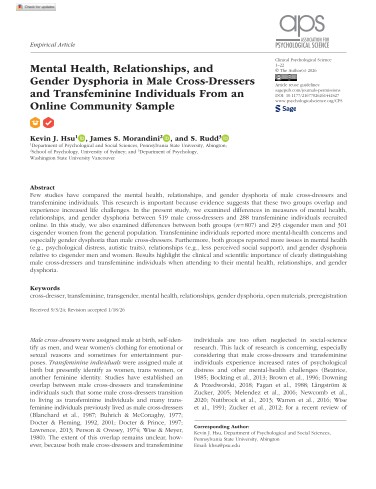
The evidence for its importance is substantial. In Blanchard’s Toronto clinic, some history of erotic arousal with cross-dressing was acknowledged by more than 80% of heterosexual gender-dysphoric natal males, compared with fewer than 10% of androphilic ones (Blanchard, Clemmensen & Steiner, 1987); bisexual and asexual patients, too, were far more likely than androphilic ones to report arousal to the fantasy of being a woman (Blanchard, 1989). In 571 transfeminine people in New York, the differences ran the same way—large, though not deterministic (Nuttbrock et al., 2011). The two groups also differ in childhood gender nonconformity, age of onset, fraternal birth order and other markers that are in place long before an adult identity forms (Lawrence, 2017). Across 22 studies in 16 countries, the proportion of transfeminine people who are not exclusively attracted to men tracks societal individualism (r = .88), and is highest in the most individualistic, largely Western, countries (Lawrence, 2010). In a recent comparison of 519 cross-dressers and 288 transfeminine individuals recruited online, the overwhelming majority identified as heterosexual, bisexual, asexual or pansexual, and as a combined group they scored well above control men and women on core autogynephilia (Hsu, Morandini & Rudd, 2025). Natal women, contrary to a popular claim, score like non-autogynephilic men, far below autogynephilic samples (Bailey & Hsu, 2022).
The cost of that omission falls hardest on the young. In our research, most autogynephilic participants first experienced the arousal by early adolescence, yet more than half did not learn the term until age 21 or later, and some first met it as a slur. A fifteen-year-old with this orientation who is handed the Genderbread has one place to put an intense, persistent wish to be female: identity. From the other side of politics, he will be told it is “just a fetish.” Neither framing gives him an accurate, non-shaming account of his own sexuality, or a view of the full range of lives—cross-dresser, non-binary person, trans woman—that people with the same orientation build.
A better gingerbread
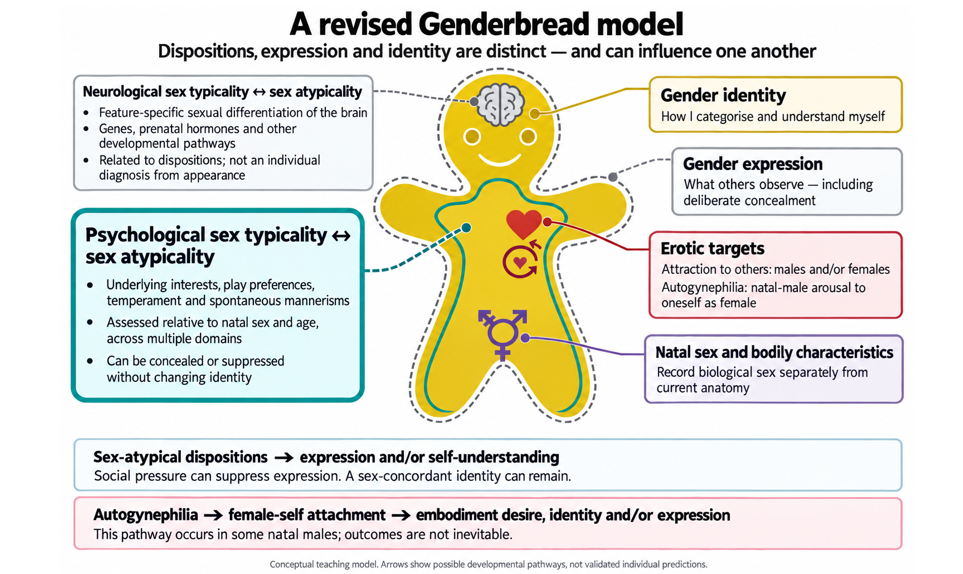
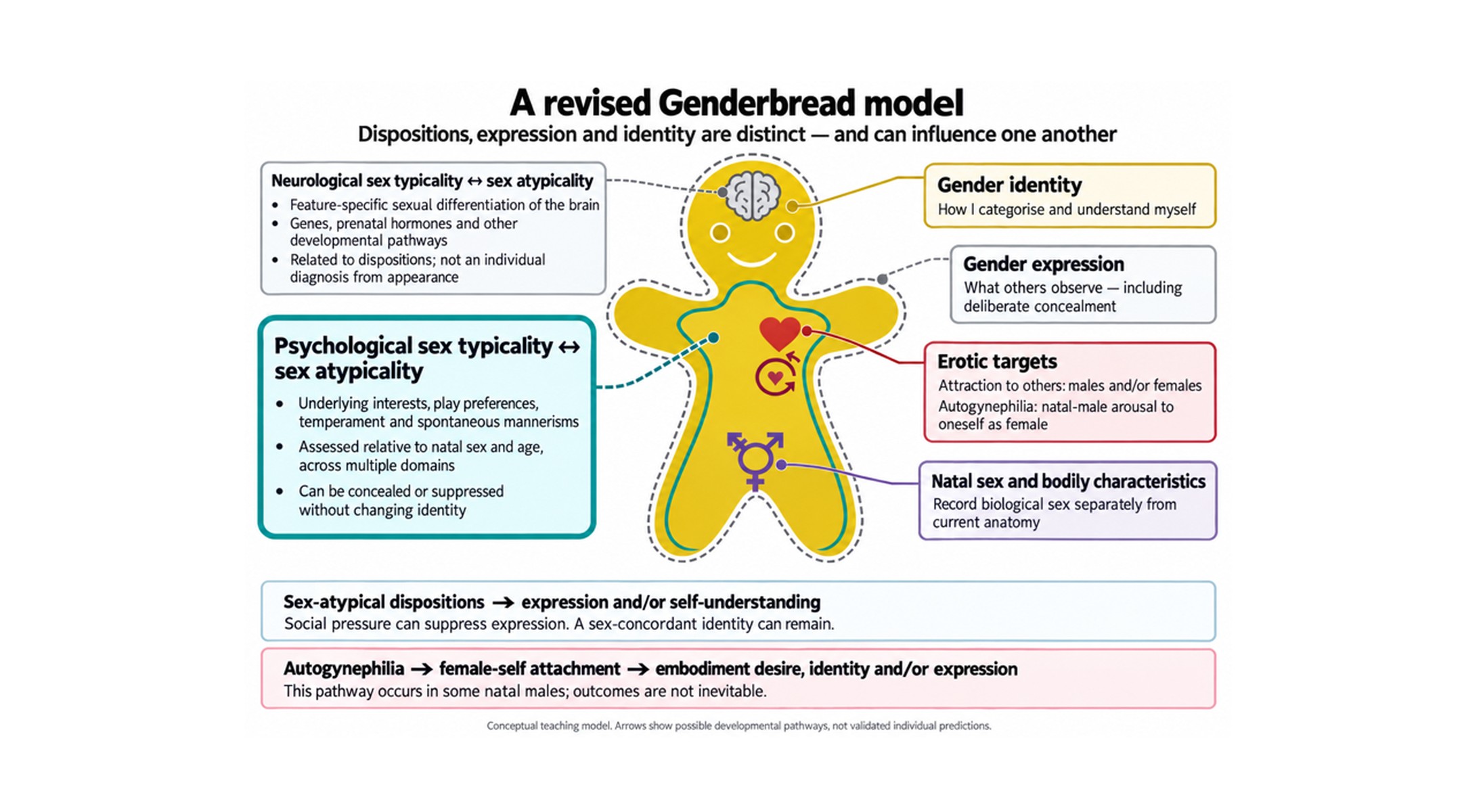
The revision I now use keeps what the original gets right and adds what it leaves out. The inner outline represents dispositions; the outer outline represents expression. Psychological sex typicality—interests, play preferences, temperament and spontaneous mannerisms, assessed relative to natal sex and age—gets its own place, alongside neurological sex typicality, with an explicit note that both can be concealed without any change in identity. Gender identity is defined plainly as how I categorise and understand myself. Expression becomes what others observe, including deliberate concealment. Erotic targets include autogynephilia. Natal sex is recorded separately from current anatomy.
Two arrows carry the developmental story. Sex-atypical dispositions can shape expression and self-understanding, but social pressure can suppress expression and a sex-concordant identity can remain. Autogynephilia can lead to attachment to a female self, and from there to a desire for embodiment, an identity or an expression—in some natal males, and never inevitably. It is a teaching model, not an assessment tool. Its job is to keep the most important variables in view.
Why this matters
None of this is an argument against compassion for trans people, or against careful, individualised care. It is an argument about what a conceptual framework owes the people who rely on it. A model offered to parents, children, teachers and therapists should make room for the most common developmental stories, not only the ones that fit a slogan.
The Genderbread Person, and the Gender Unicorn after it, removes the best-evidenced variable in this field—sex-typed dispositions and their robust link to sexual orientation—and with it the experiences of feminine boys, masculine girls, gender nonconforming gay men and lesbians, autistic girls who feel alien among other girls, and young natal males with an orientation few adults will name. These experiences are common. Among gender nonconforming children, they are close to typical. Leaving them off the chart does not make anyone more included. It leaves people to interpret themselves with an incomplete set of concepts, and it leaves the adults around them less able to help.
We can keep the cookie’s useful distinctions. We just need to put the missing ingredient back in.
This essay draws on my lecture series “Gender dysphoria is not one thing.” For research, first-person accounts and resources on autogynephilia, see Understanding Autogynephilia.
References
- Ambady, N., Hallahan, M., & Conner, B. (1999). Accuracy of judgments of sexual orientation from thin slices of behavior. Journal of Personality and Social Psychology. https://doi.org/10.1037/0022-3514.77.3.538
- American Psychiatric Association. (2022). Diagnostic and statistical manual of mental disorders (5th ed., text rev.).
- Bailey, J. M., Dunne, M. P., & Martin, N. G. (2000). Genetic and environmental influences on sexual orientation and its correlates in an Australian twin sample. Journal of Personality and Social Psychology. https://doi.org/10.1037/0022-3514.78.3.524
- Bailey, J. M., & Hsu, K. J. (2022). How autogynephilic are natal females? Archives of Sexual Behavior. https://doi.org/10.1007/s10508-022-02359-8
- Bailey, J. M., & Zucker, K. J. (1995). Childhood sex-typed behavior and sexual orientation: A conceptual analysis and quantitative review. Developmental Psychology. https://doi.org/10.1037/0012-1649.31.1.43
- Baron-Cohen, S., et al. (2015). The “Reading the Mind in the Eyes” test: Complete absence of typical sex difference in ~400 men and women with autism. PLoS ONE. https://doi.org/10.1371/journal.pone.0136521
- Bejerot, S., et al. (2012). The extreme male brain revisited: Gender coherence in adults with autism spectrum disorder. British Journal of Psychiatry. https://doi.org/10.1192/bjp.bp.111.097899
- Blanchard, R., Clemmensen, L. H., & Steiner, B. W. (1987). Heterosexual and homosexual gender dysphoria. Archives of Sexual Behavior. https://doi.org/10.1007/BF01542067
- Blanchard, R. (1989). The concept of autogynephilia and the typology of male gender dysphoria. Journal of Nervous and Mental Disease. https://doi.org/10.1097/00005053-198910000-00004
- Drummond, K. D., Bradley, S. J., Peterson-Badali, M., & Zucker, K. J. (2008). A follow-up study of girls with gender identity disorder. Developmental Psychology. https://doi.org/10.1037/0012-1649.44.1.34
- Egan, S. K., & Perry, D. G. (2001). Gender identity: A multidimensional analysis with implications for psychosocial adjustment. Developmental Psychology. https://doi.org/10.1037/0012-1649.37.4.451
- Gómez Jiménez, F. R., et al. (2021). Occupational preferences and recalled childhood sex-atypical behavior among Istmo Zapotec men, women, and muxes. Human Nature. https://doi.org/10.1007/s12110-021-09417-5
- Gómez Jiménez, F. R., Dhillon, A. K., & VanderLaan, D. P. (2025). Sexual and gender diversity in Thailand: Associations with recalled childhood sex-typed behavior and adulthood occupational preferences. Archives of Sexual Behavior. https://doi.org/10.1007/s10508-025-03121-6
- Greenberg, D. M., Warrier, V., Allison, C., & Baron-Cohen, S. (2018). Testing the Empathizing–Systemizing theory of sex differences and the Extreme Male Brain theory of autism in half a million people. Proceedings of the National Academy of Sciences. https://doi.org/10.1073/pnas.1811032115
- Hsu, K. J., Morandini, J. S., & Rudd, S. (2025). Cut from the same cloth? Comparing the sexuality of male cross-dressers and transfeminine individuals through the conceptual framework of autogynephilia. Archives of Sexual Behavior. https://doi.org/10.1007/s10508-024-03053-7
- Johnson, K. L., Gill, S., Reichman, V., & Tassinary, L. G. (2007). Swagger, sway, and sexuality: Judging sexual orientation from body motion and morphology. Journal of Personality and Social Psychology. https://doi.org/10.1037/0022-3514.93.3.321
- Landolt, M. A., Bartholomew, K., Saffrey, C., Oram, D., & Perlman, D. (2004). Gender nonconformity, childhood rejection, and adult attachment: A study of gay men. Archives of Sexual Behavior. https://doi.org/10.1023/B:ASEB.0000014326.64934.50
- Lawrence, A. A. (2007). Becoming what we love: Autogynephilic transsexualism conceptualized as an expression of romantic love. Perspectives in Biology and Medicine. https://doi.org/10.1353/pbm.2007.0050
- Lawrence, A. A. (2010). Societal individualism predicts prevalence of nonhomosexual orientation in male-to-female transsexualism. Archives of Sexual Behavior. https://doi.org/10.1007/s10508-008-9420-3
- Lawrence, A. A. (2017). Autogynephilia and the typology of male-to-female transsexualism: Concepts and controversies. European Psychologist. https://doi.org/10.1027/1016-9040/a000276
- Li, G., Kung, K. T. F., & Hines, M. (2017). Childhood gender-typed behavior and adolescent sexual orientation: A longitudinal population-based study. Developmental Psychology. https://doi.org/10.1037/dev0000281
- Lippa, R. A. (2002). Gender-related traits of heterosexual and homosexual men and women. Archives of Sexual Behavior. https://doi.org/10.1023/A:1014035302843
- Lippa, R. A. (2008). Sex differences and sexual orientation differences in personality: Findings from the BBC internet survey. Archives of Sexual Behavior. https://doi.org/10.1007/s10508-007-9267-z
- Nuttbrock, L., et al. (2011). A further assessment of Blanchard’s typology of homosexual versus non-homosexual or autogynephilic gender dysphoria. Archives of Sexual Behavior. https://doi.org/10.1007/s10508-009-9579-2
- Olson, K. R., Durwood, L., Horton, R., Gallagher, N. M., & Devor, A. (2022). Gender identity 5 years after social transition. Pediatrics. https://doi.org/10.1542/peds.2021-056082
- Rieger, G., Linsenmeier, J. A. W., Gygax, L., & Bailey, J. M. (2008). Sexual orientation and childhood gender nonconformity: Evidence from home videos. Developmental Psychology. https://doi.org/10.1037/0012-1649.44.1.46
- Rieger, G., Linsenmeier, J. A. W., Gygax, L., Garcia, S., & Bailey, J. M. (2010). Dissecting “gaydar”: Accuracy and the role of masculinity–femininity. Archives of Sexual Behavior. https://doi.org/10.1007/s10508-008-9405-2
- Sánchez, F. J., & Vilain, E. (2012). “Straight-acting gays”: The relationship between masculine consciousness, anti-effeminacy, and negative gay identity. Archives of Sexual Behavior. https://doi.org/10.1007/s10508-012-9912-z
- Semenyna, S. W., & Vasey, P. L. (2016). The relationship between adult occupational preferences and childhood gender nonconformity among Samoan women, men, and fa’afafine. Human Nature. https://doi.org/10.1007/s12110-016-9258-7
- Singh, D., Bradley, S. J., & Zucker, K. J. (2021). A follow-up study of boys with gender identity disorder. Frontiers in Psychiatry. https://doi.org/10.3389/fpsyt.2021.632784
- Steensma, T. D., van der Ende, J., Verhulst, F. C., & Cohen-Kettenis, P. T. (2013). Gender variance in childhood and sexual orientation in adulthood: A prospective study. Journal of Sexual Medicine. https://doi.org/10.1111/j.1743-6109.2012.02701.x
- Taywaditep, K. J. (2002). Marginalization among the marginalized: Gay men’s anti-effeminacy attitudes. Journal of Homosexuality. https://doi.org/10.1300/J082v42n01_01
- Warrier, V., et al. (2020). Elevated rates of autism, other neurodevelopmental and psychiatric diagnoses, and autistic traits in transgender and gender-diverse individuals. Nature Communications. https://doi.org/10.1038/s41467-020-17794-1
- Yunger, J. L., Carver, P. R., & Perry, D. G. (2004). Does gender identity influence children’s psychological well-being? Developmental Psychology. https://doi.org/10.1037/0012-1649.40.4.572